
Chiropractic for Older Adults: What a Trial Found About Balance and Falls Risk
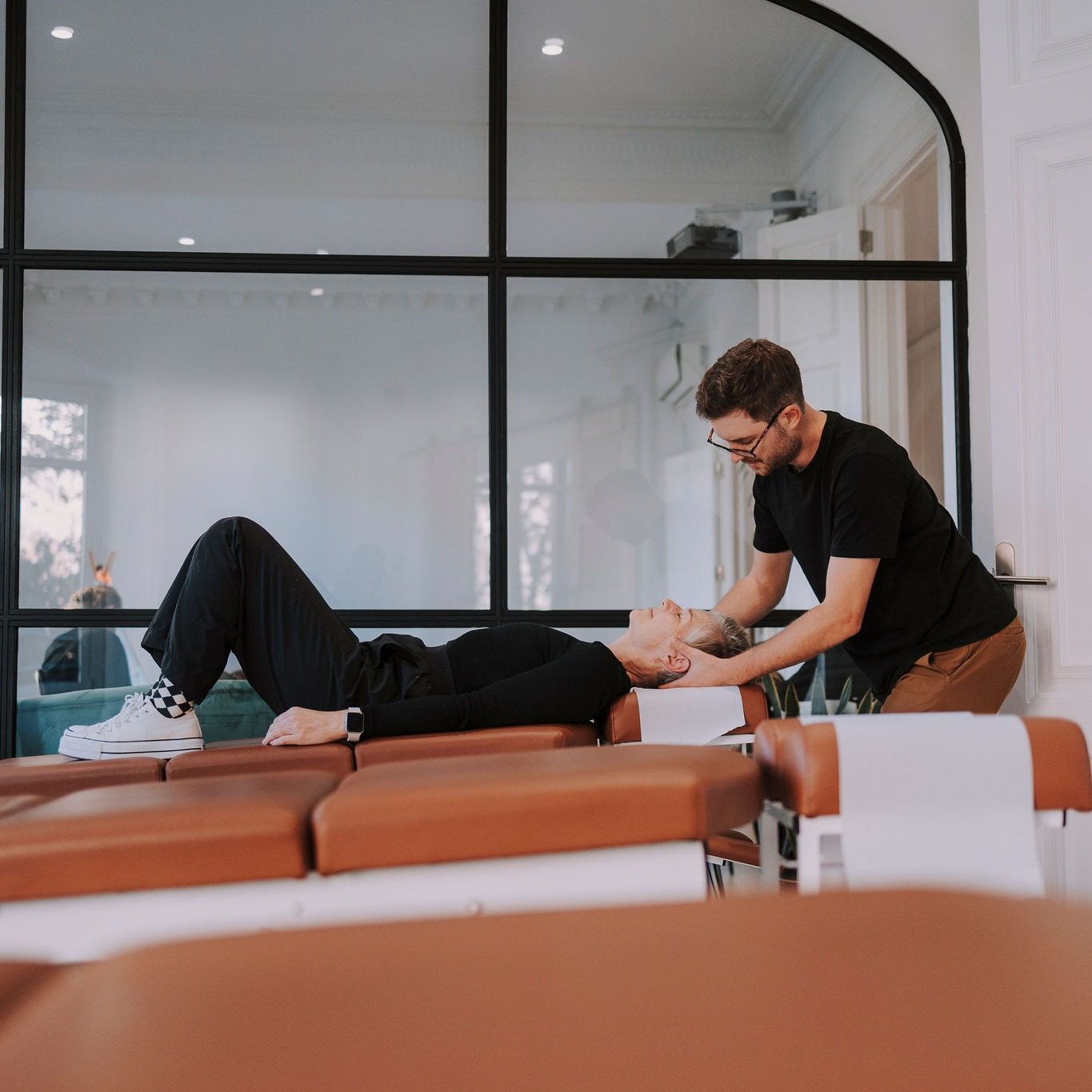
Short answer: in a randomised controlled trial of 60 adults over 65, the group that received 12 weeks of chiropractic care reacted 119 milliseconds faster in a stepping test than the group that did not, and sensed the position of their ankle more accurately. Those are two of the abilities that decline before a fall. The trial measured falls-risk factors, not falls, so it doesn’t prove chiropractic prevents falls. It does show that the ageing nervous system responds to care.
If you have a parent or grandparent who has started holding the handrail a little tighter, this one is for you.
Why falls are really a nervous-system problem
About one in four adults over 65 falls every year, and falls are the leading cause of injury death in that age group. Weak legs are only part of the story. Staying upright depends on how fast your brain notices you are losing balance, how accurately it knows where your feet and ankles are, and how quickly it gets a foot out to catch you. All of that is nervous-system work, and all of it slows with age.
The trial: 60 adults, 12 weeks
In 2016, Kelly Holt, Heidi Haavik and colleagues randomly split 60 adults over 65 into two groups. One received chiropractic care for 12 weeks. The other received usual care, with no chiropractic.
Compared with the control group, the chiropractic group:
- reacted 119 milliseconds faster in a choice-stepping test, where you have to step quickly in response to a signal (p = 0.01). In a stumble, a tenth of a second is the difference between catching yourself and hitting the floor.
- sensed ankle position more accurately, by about 0.2 degrees (p = 0.049).
- processed sight and sound together better, by 13.5% in a test of multisensory integration (p = 0.01).
- reported better physical quality of life on a standard questionnaire (SF-36, +2.4 points, p = 0.04).
One thing did not improve significantly: postural stability, how much people swayed while standing still. We mention it because it was measured and it didn’t move.
How it might work
A separate study by Haavik and Murphy found that a single adjustment to the neck sharpened people’s sense of where their arm was in space, what scientists call joint position sense, or proprioception. The idea that links the two studies is the one behind all our work: the adjustment changes the information your spine sends your brain, and the brain updates how it senses and controls your body.
What this trial cannot tell you
- It measured risk factors, not falls. Nobody has yet shown that chiropractic care reduces the number of falls or fractures. We won’t claim it does.
- The control group got no care, not a sham, so some of the effect could come from the attention and the visits themselves.
- It was one trial, with 60 people. Bigger studies are needed.
What we can say honestly: the systems that fail before a fall improved, measurably, in people over 65.
What we do with older practice members
We start with a full history, including falls, medication, bone density and any osteoporosis, because those details change how we adjust. For older spines we often use low-force techniques, such as an instrument or a drop table, instead of manual adjustments. And we work alongside your doctor and, where it helps, a physiotherapist or strength coach. Balance is a team sport. See family chiropractic and what happens at your first visit.
Frequently asked questions
Is chiropractic care safe for older adults? Yes, with the right assessment. We ask about osteoporosis, blood thinners and previous fractures first, and choose gentle, low-force techniques when they’re the better fit.
Can chiropractic care prevent falls? No study has shown that yet. A randomised trial found it improved reaction time and ankle position sense, which are falls-risk factors. That’s promising, but it isn’t the same as preventing falls.
How long did it take to see a change in the trial? The measurements were taken after 12 weeks of care.
Should my parent stop their balance exercises or physiotherapy? No. Chiropractic care works alongside exercise and medical care, not instead of them.
The sources
- Holt KR, Haavik H, Lee AC, Murphy B, Elley CR. Effectiveness of chiropractic care to improve sensorimotor function associated with falls risk in older people: a randomized controlled trial. Journal of Manipulative and Physiological Therapeutics, 2016. PubMed
- Haavik H, Murphy B. Subclinical neck pain and the effects of cervical manipulation on elbow joint position sense. Journal of Manipulative and Physiological Therapeutics, 2011. PubMed
- Centers for Disease Control and Prevention. Older Adult Fall Prevention. CDC
Worried about a parent’s balance? Book an assessment and bring them with you.